When Yirga Abay first enrolled in a GWC course, he wanted to strengthen one skill. What he discovered after taking five GWC courses was something much bigger: a complete framework for developing sustainable solar powered water systems from the ground up.
Yirga is the first learner to complete five GWC online courses, demonstrating an extraordinary commitment to professional growth and a desire to create lasting water solutions in his community and beyond.


“It is a pleasure to share how these courses have directly transformed my daily engineering work,” Yirga said. “The curriculum is perfectly integrated, bridging the gap between groundwater science, groundwater resource management, and technical system design.”
For Yirga, the true value of the courses was not found in any single subject area. Instead, it was the way the courses connected together to create a holistic understanding of water systems and the people who depend on them.
“These five courses are all interconnected because only designing solar powered water systems without knowing its impact on the surrounding environment is incomplete work,” he explained. “All the courses I took help develop a complete solar powered water system… implementing it for the best possible use and sustainable management of natural resources with less environmental impact.”
That broader perspective changed how Yirga approaches his work. Before taking the courses, Yirga often struggled to evaluate the long-term sustainability of water systems. Through GWC’s training, he gained the practical skills to apply these concepts in the field.
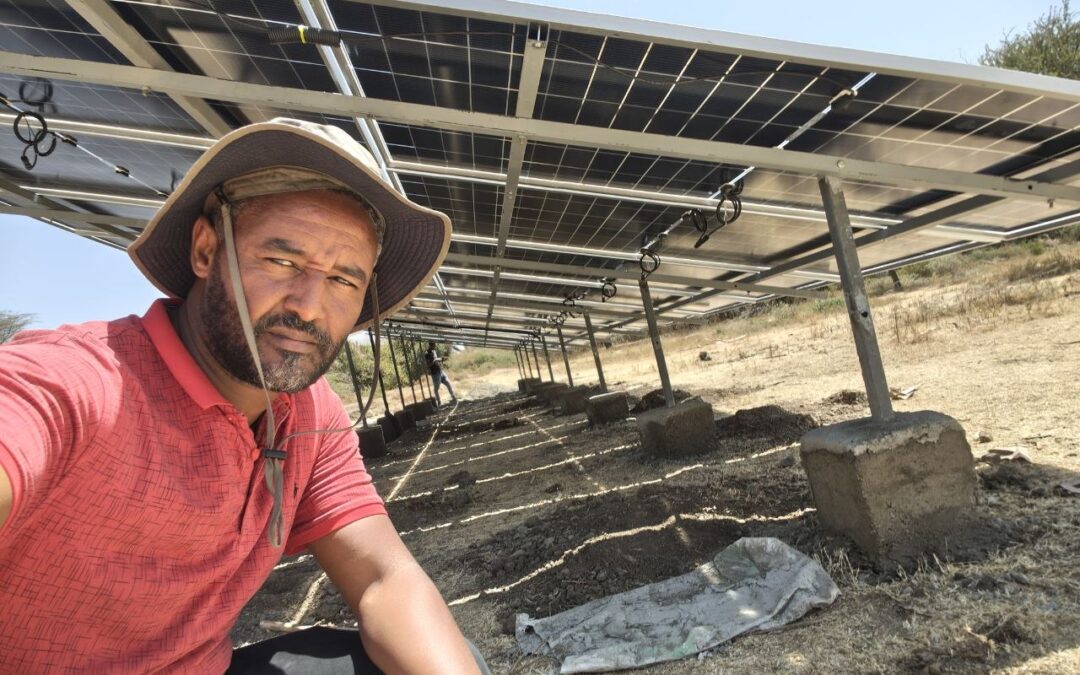
Shortly after taking the courses, Yirga began a project in Meki City, Ethiopia, where he converted a diesel-powered irrigation system to run on solar energy. The project is helping bring previously unused farmland back into production, creating new opportunities for food production and economic growth in the community.
“The GWC courses gave me the confidence and complete tools to do this work,” Yirga said. “Now I can deliver solar powered water projects that can help rural communities get clean water and help farmers make use of their land without waiting for the rainy season.”


For Yirga, the impact extends beyond a single project. As founder of AquaSun Electromechanical Solution PLC and an electrical engineer and business developer with Dabus Consult PLC, he is applying what he has learned to help communities, organizations, and landowners make better use of water resources.
The flexibility and accessibility of GWC’s online learning platform also played an important role in his success. As Yirga explained, “The self-paced schedule was essential, allowing me to learn even while working in remote areas with limited connectivity.”
Yirga’s journey reflects a simple truth: lasting water systems depend on skilled, supported professionals who have access to the knowledge, resources, and connections they need to excel. When people are equipped to do their work with excellence, the benefits ripple out to their communities.
Yirga is quick to credit the support he received throughout his learning journey. “I would like to thank GWC as an organization and all the facilitators of the program for the effort they put in to help us finish the courses,” he said.
Congratulations, Yirga, on this remarkable milestone, and thank you for sharing your story with the GWC community. We are grateful to be part of your learning journey and look forward to seeing the impact you continue to make in the years ahead.
Always SPWSP (solar powered water supply project reduce running cost .but in some area especially in southern Highlands works better during rain seasons.I advice to use both solar and electricity as source of energy to our WSP to provide enough and safe water supply to the customers
Thanks for your insight!
I advice to use both solar and electricity as source of energy to our WSP to provide enough and safe water supply to the customers.more predictive maintenance knowledge needed.But also GWC provide nice knowledge on Maintaining WSP.
Agree but that’s only possible for grid tied areas. Unless, you can also manage your demand in PSH if possible.
It is true to use spwsp as source of power at our ground, source it gives the cheapest operation of our project but I advice to use electricity as extra source of power incase to backup the operation during rainy season.
Thank you GWC & team GW for this priceless opportunity and follow up of your trainee. I’m very grateful.
Yirga- Thank you for sharing your story! It was wonderful to hear how you’re applying the course information to your work.
Thanks for sharing!
It is true that using SPWSP as the primary source of power at our site provides the most cost-effective operation for the project. However, I recommend using electricity as an additional power source to serve as a backup during the rainy season. In other words, electricity should be available to ensure uninterrupted operation whenever the SPWSP system is affected by unfavorable weather conditions
Thanks for sharing your insights.
Dear Yirga ,
thank you for sharing your hands on experience on solar-garden project . Love to invest in similar projects . But few worries on some . Can you share your thoughts on :
1) pay back period of your investment – I see that you are growing tomatoes
2) Do you have access to national grid connections? Is it economic choice to use solar energy than the grid system or is it the other way
3) How safe is your investment against vandalism or robbery?
Dear Mengistu,
Thank you for the compliment! Contact me through [email protected] and we’ll have some chats about the ROI and all your worries so that hopefully you’ll get all you want to decide about your investment.
Thanks for reading the story and sharing your questions. I hope you and Yirga can talk soon.
“One person, the right skills, big change. Congratulations Yirga!
Thank you very much Godlisten Swai!!