
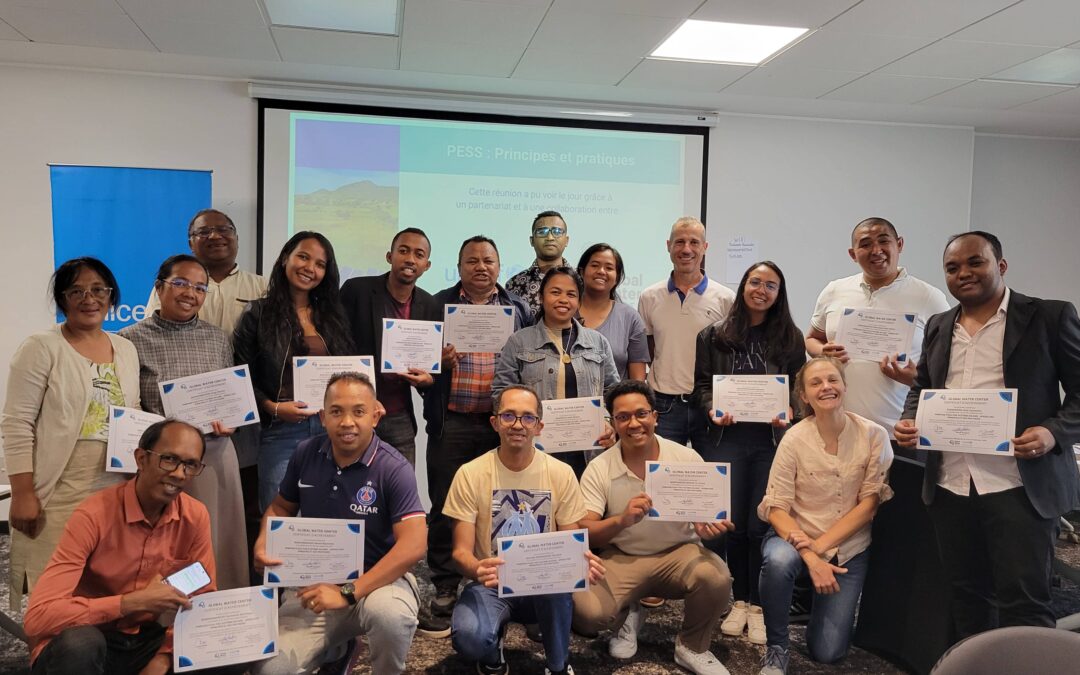
During a field visit outside Antananarivo, Madagascar, water professionals assessed a working water system as part of a Global Water Center (GWC) training. One question guided their assessment: What are the greatest risks to its long-term success?
After a thorough inspection of the system and the context that the system was operating in, the group settled on a few key conclusions. The system was well-designed and well-operated, but its solar powered pump needed repairs.
Some participants identified the pump as the biggest concern. A backup pump was keeping water flowing, but it could only be operated by electricity from the grid, adding significant monthly costs. Others looked beyond the equipment to a nearby lake, where surrounding activities and environmental conditions could threaten the water source itself.
The discussion revealed an important distinction. The pump problem could be fixed with money and technical expertise. Protecting the lake and its surrounding environment would require a much broader, long-term approach.
For Kendra Driscoll, GWC’s Senior Advisor of Curriculum Design, it was one of the most memorable moments of the week. Participants were moving beyond short-term fixes to think about what it would take to keep the entire water system working for years to come.

A Growing Need for Sustainable Water Systems
Across Madagascar, solar powered water systems are expanding rapidly. UNICEF is supporting the development of hundreds of systems, creating new opportunities for communities to access safe water.
But installing new infrastructure is only part of the solution.
Once a system is built, someone must operate it, maintain its equipment, manage costs, and plan for repairs. Without the right technical knowledge, management practices, and financial planning, systems can break down and remain out of service for months—or even permanently.
When that happens, communities may lose access to water, and valuable resources may have to be spent building new systems rather than restoring existing ones.
An effective solution is not only about getting water flowing but keeping it flowing.
That’s why GWC partnered with UNICEF Madagascar to deliver a five-day training focused on the long-term sustainability of solar powered water systems.
The training brought together 24 participants during the week, with 19 completing the full course. Participants represented Madagascar’s Ministry of Water, Sanitation and Hygiene, UNICEF, WaterAid, GRET, utilities, private companies, and other organizations working in the water sector. Among them were engineers, technicians, planners, managers, and water operators, each responsible for different parts of delivering and sustaining water services.

Looking Beyond the Technology
Through the workshop, Kendra and facilitators Marion Nonglaton and Julien Labas, introduced participants to the Technology Applicability Framework, a tool for examining the different factors that influence whether a water system will be sustainable in the long run.
Throughout the week, participants explored how technical design, financial planning, environmental conditions, management, and other considerations affect the long-term success of solar–powered water systems.
One of the most engaging exercises came on the third day, when participants stepped into roles different from their everyday work. Some became water users. Others represented system operators, managers, funders, or government agencies. Together, they worked through a fictional case study, discussing whether a proposed water system should move forward.
Each role brought different priorities and concerns to the conversation. Afterward, participants discussed how those same challenges were playing out in Madagascar. For the training team, the discussion demonstrated the value of stepping outside one’s usual responsibilities to see the larger picture.
A group of young engineers from a private company particularly stood out. They had not previously participated in training focused on water system sustainability. The exercises offered them a new perspective on how their technical work connects to the broader conditions needed for a system to succeed.

Building the Skills to Keep Water Flowing
The true value of the training lies in how participants take what they learn in the classroom and apply it to their everyday work. By considering sustainability from the beginning, water professionals can make more informed decisions about design, management, maintenance, and long-term planning. That becomes increasingly important as Madagascar expands its water infrastructure.
Kendra hopes the training will help participants look beyond the immediate demands of their work and consider what their systems will need five, ten, or more years into the future.
As more water systems are built across Madagascar, equipping the people responsible for their long-term success will be essential to making those investments last.