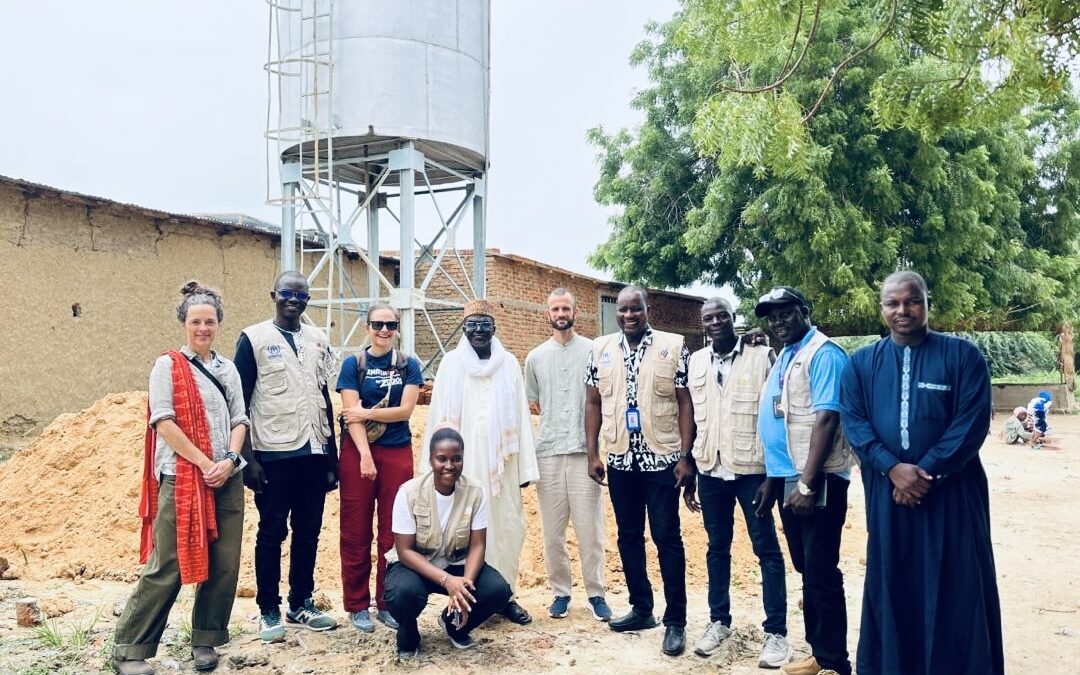
When Heidi Fuller returned from Chad, one thing stayed with her more than anything else: the people.
Heidi, GWC’s Director of Training, traveled to Chad in August to conduct site visits, meet with UNICEF and other partners, and lead a five-day training on designing solar powered water systems (SPWS).
At each site visit, Heidi and her colleagues met with those responsible for the water system and the community it served, listening to and learning from their experiences. In one village, she sat with the local chief and water council under the trees, sharing conversation and hospitality. The experience showed Heidi how deeply people value relationships in Chad, and how those relationships create the foundation for the work.

“Going to a place like this and seeing firsthand the extreme political and environmental challenges people are facing daily, and then experiencing the deep kindness, warmth, and grace they share, changes you,” she reflected. “It anchors me in humanity.”
During the inspection of the SPWS, the team climbed to the top of the village water tank and looked down to see children sitting on the ground below, doing their schoolwork.
“When water is available and safe to drink, learning becomes a possibility,” Heidi reflected. “These are the moments that stay with you.”
These visits came alongside a meeting hosted by GWC and UNICEF and attended by representatives from the African Development Bank and a collection of implementing organizations. They discussed what’s working, where challenges remain, and what technical skills are needed to address the gaps.
Just three days later, GWC began responding to those needs.
From August 24–28, Heidi and consultants Nadim Charara and Marion Nonglaton led a training on designing solar powered water systems. Thirty-five participants joined from UNICEF Chad and Cameroon, the Ministries of Water and Energy, Education and Health, LM International, and two local NGOs.


The training was grounded in the realities participants are facing in Chad. They practiced designing systems for realistic scenarios, including one based in a refugee camp located in eastern Chad. The training combined technical instruction with group design exercises, 3D models, and a field visit to an operating water system.
Participants worked through the full design process, from calculating water needs and assessing available water sources to selecting equipment and planning for long-term maintenance.
The response was strong. 100% of participants said they would recommend the training to a colleague, and 100% rated it relevant, practical, and useful. Nearly 88% said applying what they learned was an absolute priority.
And they were already thinking about what comes next. Participants identified areas where they want to build deeper skills, including hybrid powered systems, maintenance, and training that reaches into the more remote areas of the country.
Those needs are helping shape a path forward. With newly trained technicians, growing relationships with UNICEF and Chad’s Ministry of Water and Energy, and a clear understanding of what’s needed, there is a real opportunity to keep expanding this work.

For Heidi, the people she met in Chad are what made the trip unforgettable. For GWC, they are also what makes the path forward so meaningful. We’re excited to keep walking alongside partners in Chad as this work grows and more communities gain access to safe, reliable water.