Global Water Center (GWC) supports water professionals around the world through training, technical support, and practical resources. Every day, these professionals navigate complex challenges in their work.
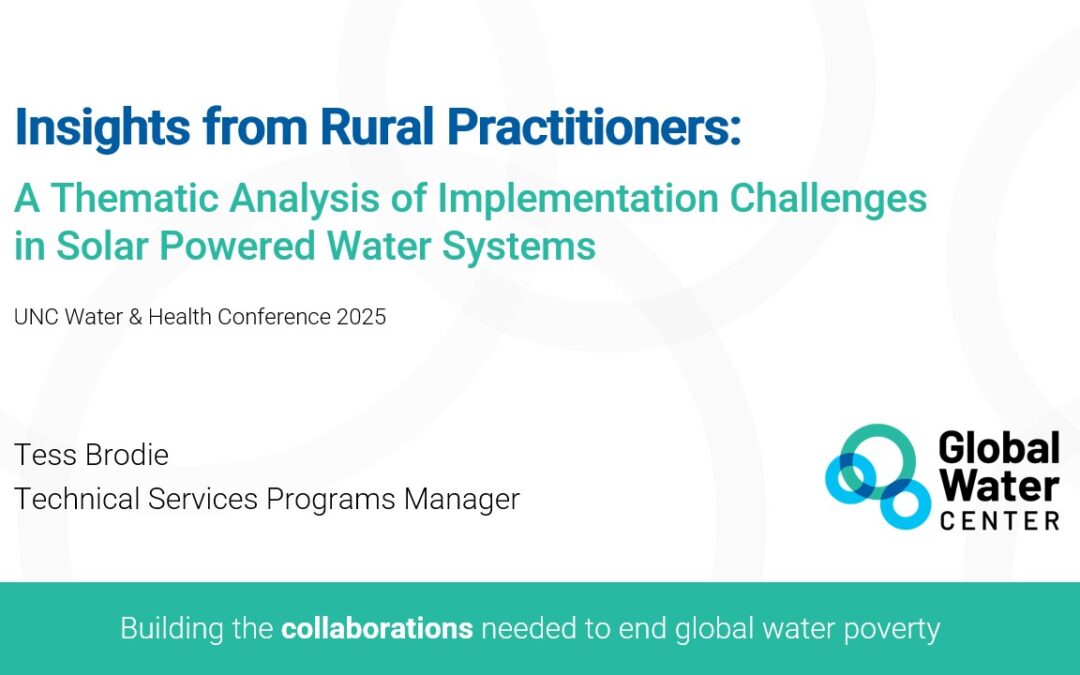
To better understand those challenges, Tess Brodie, Technical Services Programs Manager at GWC, analyzed practitioner experiences with solar powered water systems.
Why This Research Matters
Solar powered water systems play an important role in expanding rural water access. Their success depends on the water professionals who design, operate, and maintain them.
For GWC, supporting these professionals well means listening closely to their experiences. Understanding what works, what does not, and where support is needed allows GWC to tailor training, technical assistance, and resources more effectively.
This research was used to do exactly that.
What the Analysis Was Based On
Tess examined input from water professionals who participated in Solar Powered Water Systems (SPWS): Principles & Practices, delivered to two groups:
- A global online course with 502 participants from 66 countries
- A dedicated RUWASA Tanzania cohort with 285 Tanzanian water professionals representing regions across the country
Participants were asked the same set of discussion questions about whether solar powered water systems had been installed in their region and what their experience had been.
Using a thematic analysis approach, Tess identified common patterns across responses and explored how challenges varied by region.
What Water Professionals Shared
Across countries and contexts, water professionals described similar challenges affecting solar powered water systems, including:
- System design and sizing issues
- Operations and maintenance constraints
- Financial planning and lifecycle cost challenges
- Limited access to spare parts and technical support
- Gaps in hands-on experience and technical skills
In Tanzania, regional differences also emerged. Participants highlighted the importance of accounting for seasonal variability, strengthening operator support, and improving coordination between engineers and operators.
Sharing the Findings With the Sector
Tess presented this research at the UNC Water & Health Conference, sharing practitioner-centered evidence with sector leaders, researchers, and implementers.
The presentation emphasized a critical message: Investing in people is essential for solar powered water systems to perform well over time.
From Insight to Action
The findings from this research now inform how GWC supports water professionals. Understanding the challenges that water professionals face every day helps GWC focus capacity development and technical support where it is needed most.
When water professionals are equipped with the right skills, tools, and support, solar powered water systems are more likely to deliver reliable water services for the communities that depend on them.
That is why Global Water Center continues to invest in people, strengthening the professionals who make sustainable water access possible.
How to participate in the research program
I would like to know more detailed information about your research.